Unknown's avatar

About Plant Some Joy

Spread joy with fun and easy ways to add plants to your life.

Use your rosemary!

Got a pot of rosemary growing? Sure, it’s beautiful. It’s really useful too! One of my favorite ways to use it is with roasted vegetables. Choose whatever root vegetables you like. Potatoes are wonderful of course, as are carrots, parsnips, sweet potatoes, yams, turnips, and rutabagas. Brussels sprouts, cauliflower, cabbage, and squash also roast well.

Chop up whatever you like and place it on a rimmed baking sheet. Above, I’ve used carrots, red potatoes, and butternut squash. Add 2 or 3 sprigs of rosemary and drizzle the whole thing with a couple tablespoons of olive oil. Season with salt and pepper and toss everything with your (washed) hands to distribute the oil. Roast in a 400-degree oven. Give the vegetables a stir after 15 minutes or so. Continue roasting until the vegetables are just soft on the inside and nicely browned on the outside, as pictured on the right, above. Generally this takes about 45 minutes. Discard the rosemary before serving.

Feeling festive? The following rosemary-infused cocktail is simple yet delicious. Perfect for winter!

  • 1 oz. cranberry juice
  • 2 tablespoons rosemary simple syrup
  • 4 oz. prosecco

Chill all ingredients then pour in the order listed into a champagne flute or white wine glass. Give it a quick stir to combine and enjoy!

Rosemary simple syrup:

  • 1 cup sugar
  • 1 cup water
  • 3 sprigs fresh rosemary

Combine sugar, water, and rosemary in a small saucepan. Bring to a boil over medium heat and stir to dissolve sugar. Turn heat off and let syrup cool in the pot. Strain the syrup to remove rosemary sprigs and any leaves that might have fallen off. Keeps for months covered and refrigerated.


How to freeze garlic

Having a stash of peeled garlic in the freezer is a terrific time-saver. You can freeze it in various forms, as described below for about a year. Pick whatever form you find most convenient.

Whole raw cloves–Scatter whole peeled cloves of garlic on a rimmed baking sheet and place in the freezer overnight. The next day, use a flat spatula to loosen the cloves. Place them in freezer bags or airtight containers and store in the freezer.

Chopped or minced raw cloves–Chop or mince peeled garlic, make tablespoon-sized mounds on a parchment-lined rimmed baking sheet, then place in the freezer. The next day, loosen the garlic mounds and freeze as described above. You can also suspend the garlic in olive o

garlic paste with olive oil in food processor and small trays ready to freeze (3).JPG

Mincing garlic is fast and easy in a small food processor. Loosen it with a little olive oil. These cool little trays are from my niece’s Pampered Chef party.

il by adding a little to the minced garlic before freezing. Old ice cube trays work great for freezing a garlic/oil mixture. Once it is frozen, pop the “cubes” from the tray and store them in the freezer in freezer bags or airtight containers. Frozen chopped or minced garlic is super convenient for making garlic bread, sauces, and dressings.

Roasted garlic–Roasted garlic is a vastly different creature than raw garlic—mellow, nutty, and slightly smokey. It’s delicious spread on bread or crackers and in dressings. Garlic can be roasted by placing whole peeled cloves on a rimmed baking sheet, tossing them with a little olive oil, and roasting at 350 degrees til soft. Alternatively, slice the heads longitudinally, place them in a small baking dish or piece of foil, and brush with olive oil. Either cover the baking dish with foil, or wrap the heads in foil and roast at 400 degrees until the garlic is soft. Let cool slightly then squeeze each half to release the cloves. Freeze roasted garlic in airtight containers or freezer bags.

Consider the winter garden

Most people don’t think about their gardens in winter. Who wants to be out in the cold more than they have to? But if you’re looking to changesnow-on-rudbeckia-black-eyed-susan-spent-flowers your landscape next summer, winter is a great time to consider your options without the distraction of foliage or flowers. Grab some paper and a pencil and come with me on a little landscape soul-searching.

First, look out your windows from indoors. What do you see? Does it please you? Now go outside and tromp around. With fresh eyes, envision what people see when they walk or drive past your house, when they walk to your front door, and drive up your driveway. What do you see when you collect the mail, take out the trash, take your kids to the bus, or walk the dog? Really look. Do you like what you see, or is it lacking? Why? Jot down all your thoughts.

Next, assess how you use or want to use your outdoor spaces. Do you have children who need play space? How about a dog? Do you want to entertain outdoors? Do you enjoy grilling outdoors? Do you want to grow edibles? Do you intend to play lawn games like badminton, bocce, or croquet? Or is having a relaxing oasis more your speed? Add these thoughts to your other notes.

It’s critical to note the physical attributes of the property too. How much sun do various parts of the property receive? Are there areas where water ponds after a rain? Are there other drainage problems? Where are all the structures on the property—house, garage, shed, children’s play house or tree house, pool, driveway, vegetable beds, septic system, gas and water lines, overhead wires, etc.? Making simple sketches helps record these important points, or you can use a copy of the survey you received when you bought your home and draw on that.

Now take your survey copy and lay tracing paper over it. Using different colored pens or markers, draw lines that represent where you drive and park your car on the property, the pattern of where your pets move around, the path you take to pick up your mail, place your trash for pickup, where your kids play, how they walk to the bus stop, how visitors travel to your front door, and other pathways that might occur on your property. This exercise can reveal faults, eyesores, and difficult access paths in a landscape.

Note the style of your house and think about garden styles you like (cottage, formal, modern, etc.). This is the time to dream and have fun. Websites like Pinterest are great for helping you find the garden styles, colors, and detail you like. Magazines and books are great resources too, as well as real gardens you may have visited. Keep track of things you like to help guide a style for your new garden space, either scrapbook style or electronically.

Taken together, your notes and sketches synthesize the facts about your landscape as well as your thoughts, desires, and needshalesia-carolina-silverbell-buds-in-snow-closeup-winter-10 for it. You can use these materials to come up with a list of changes to make: pathways to remove or change; eyesores to screen; spaces for play or lounging to create; or more pleasing views to establish.

With all your thoughts and ideas recorded, come next spring, you’ll have a starting point for creating a landscape that pleases you and suits your needs.

Chanticleer, Wayne PA

Chanticleer is a jewel among the many estate and public gardens in the U.S. Situated in the suburbs of south Philadelphia, It sits on 48 rolling acres and is aptly billed as a ‘pleasure dscf0229garden.’ It is the gift of Adolf Rosengarten Jr., whose family was in the pharmaceutical business. Rosengarten, who loved trees, made provisions before his death in 1990 to maintain the estate as a public garden.
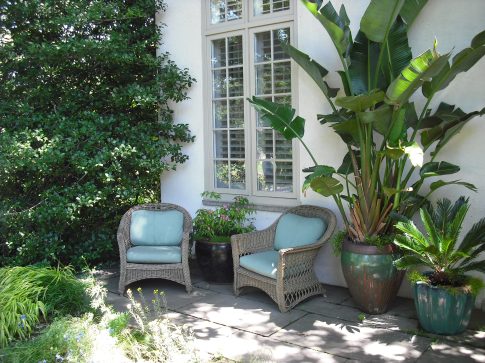
“Our vision for Chanticleer is to be one of the most beautiful gardens in the world while maintaining the feel of a private garden,” says executive director William Thomas. “We want each person to feel like a special guest of the Rosengartens.” He adds, “Chanticleer is about pleasure and beauty, but that doesn’t mean it’s not educational. We are an excellent environment in which to study plants, combinations, containers, garden design, use of structure and furniture within designs, and plant culture.”

Experienced gardeners eagerly visit Chanticleer again and again because they always find new and unusual plants used in interestidscf0193ng designs and combinations that get their creative juices flowing. Even non-gardeners love the experience too, for few public gardens combine art, horticulture, and emotion with such skill.
Plan to spend no less than a half day at Chanticleer—a full day to really see it all and take time to sit in all the wonderful handmade chairs and benches scattered throughout the garden. There is no place to buy food or drinks but you can to bring your own and picnic at one of the several designated picnic areas. More details are at www.chanticleergarden.org, phone: 610-687-4163.

The plant outside my window: native flowering dogwood

The dogwood tree outside my office window was one of the few plants on our property when my husband and I bought our house almost 19 years ago. The previous owners had planted it to commemorate the birth of their daughter five years earlier.

Initially I lamented that the tree had been planted in the wrong place—a full sun western exposure with additional reflected heat from the house’s brick siding. In the wild, flowering dogwoods are an understory tree in eastern North America, growing in the shade or at the edge of the woods. I was doubly concerned about the longevity of this tree since wild and cultivated native dogwood trees have been decimated by a fungal disease, Anthracnose. I pruned the young tree to enhance its natural elegant shape, fed it, and hoped for the best. I continue to coddle it with water during hot dry spells and feed it occasionally.

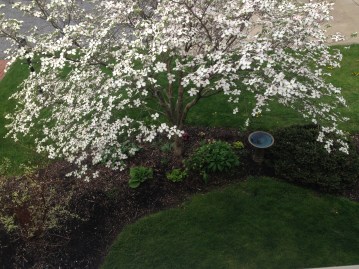
The tree has become more beautiful with each season. Its branches have spread horizontally into the classic graceful shape of flowering dogwoods. It has also grown taller so that now, from

side garden from above.JPG

The dogwood tree outside my window and a little shade garden beneath it in early spring.

my office window, I see into its upper branches. I marvel at this tree almost daily and in every season. It is a living presence, a feature of our home that we have come to love and cherish.

In late April, its flower buds awaken before the leaves, creating a cloud of white blossoms set against the blue spring sky. I have planted a little shade garden, a summer oasis for birds and chipmunks, in the ever-widening coolness of its spreading limbs. In autumn, the leaves turn fiery red and clusters of crimson berries dot the branch tips. I love watching the birds gobble those berries well into December. I keep a birdfeeder just beyond the furthest limbs, and the dogwood’s bare branches becomes a busy landing site for chickadees, cardinals, finches, blue jays, sparrows, titmice, and doves waiting to take their turn at the feeder. Squirrels make daredevil attempts to launch themselves onto the feeder from the tree’s bending branch tips. The furry scoundrels scurry up the trunk and scold me from above when I tromp outside to fil the feeders.

I never get tired of this glorious tree or the wildlife that enjoys it more than I do. Do you have a beautiful plant outside your window? I’d love to hear about it!